
As we slowly round the corner towards spring, here are a few updates from the Resource Refocus team.
recent work
NEEA Code Baseline and Assumption Review
Resource Refocus (RR), supporting Industrial Economics, Incorporated (IEc) as the project lead, recently completed a review of the Northwest Energy Efficiency Alliance’s (NEEA’s) Natural Market Baselines for commercial and residential energy codes in the Northwest on behalf of NEEA.
The review was informed by interviews with experts involved in Northwest and national building energy code development, as well as a scan of energy code savings evaluation approaches used across the country. The evaluation concluded that NEEA’s current methodology for defining Natural Market Baselines is generally reasonable and appropriate.
The work also identified opportunities to strengthen the approach. Recommendations included developing separate baseline assumptions by code update, state, and sector (residential and commercial); more clearly defining, documenting, and communicating the roles of NEEA and its partners; and adjusting code baselines to reflect the degree to which NEEA and its partners’ efforts likely accelerated code adoption—typically by one to three code cycles—based on qualitative assessment.
NEEA has indicated its intent to accept these recommendations, with a detailed response and next steps provided in the final report.
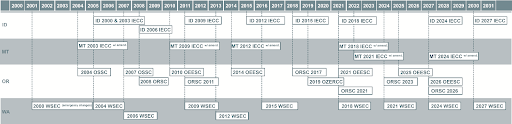
State Codes Tracked by NEEA
Oregon Structural Specialty Code (OSSC), Oregon Energy Efficiency Specialty Code (OEESC), Oregon Residential Specialty Code (ORSC), Oregon Zero Energy Ready Commercial Code (OZERCC), Washington State Energy Code (WSEC)
Propane Utilization in Buildings Across California
The final report for California Air Resources Board’s study of propane use in California, and the appetite for and potential impact of switching to zero on-site emission technologies, was released this month. The project was led by TRC, and RR led the analysis evaluating the financial, energy, and emissions impacts of switching from propane heating to different zero emission technologies.
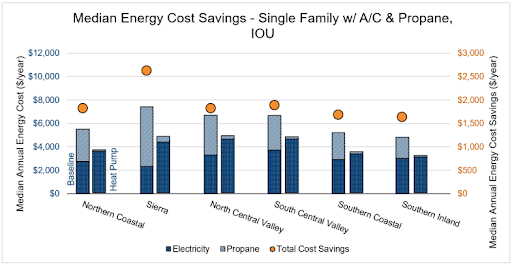
Median energy cost savings across California for single-family homes switching from propane furnaces & A/C to heat pumps.
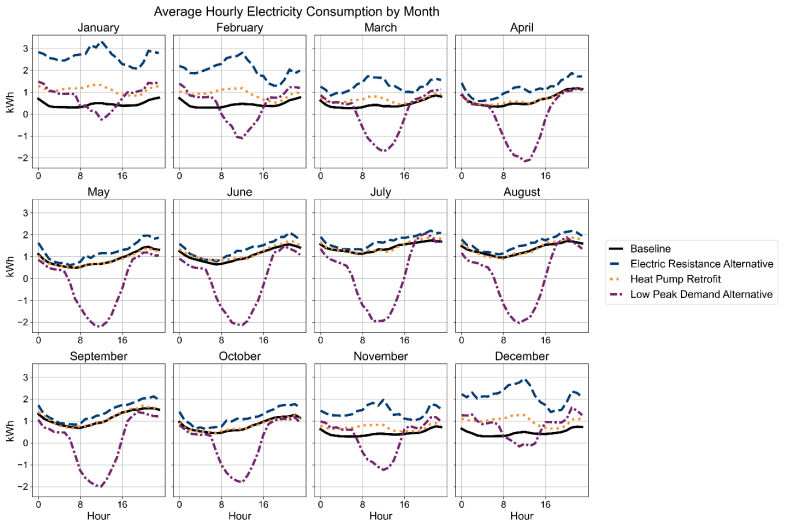
Average electric load shapes of different retrofits for propane heating (baseline) by month across California.
2027 IECC Development
Rhys Davis has been providing input and developing analysis for the 2027 residential IECC process in support of continuing to improve the model code’s requirements for envelope efficiency, provide credit for adoption of efficient HVAC and water heating systems, and provide pathways for future decarbonization and efficiency improvements.
Conferences and Virtual Events
ASHRAE Winter Conference
Dr. Carrie Brown and Rhys Davis just returned from the ASHRAE Winter Conference where Carrie delivered welcoming remarks at the Plenary. Carrie continues to serve as a Director-at-Large on the Society Board and Vice Chair of the Center of Excellence for Building Decarbonization. Other roles include GPC 49P Integration of Future Weather Data into Built Environment Analysis Vice Chair, 2026 Decarbonization Conference Vice Chair, TC 4.2 Climatic Information Research Chair, Society Rules Committee, Communications Committee, and ASHRAE 2035 Vision Ad Hoc.
Rhys continues to serve on the standards committees for ASHRAE 242p Standard Method for Calculation of Building Operational Greenhouse Gas Emissions and 90.2 High-Performance Energy Design of Residential Buildings. He is also a member of TC 7.6 Building Energy Performance.
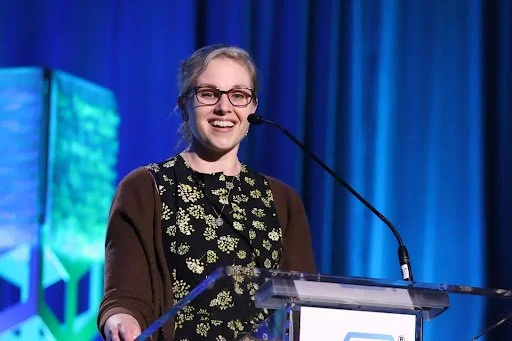
Dr. Carrie Brown
And one more thing!
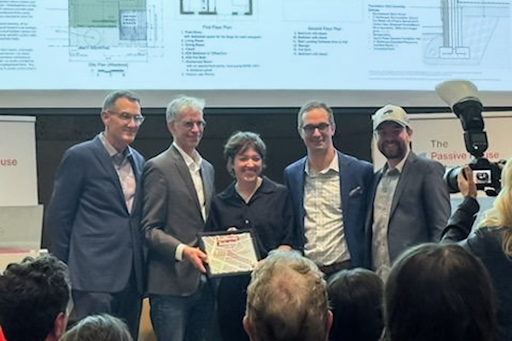
We’re delighted to highlight that former colleague Nate Heckman, now teaching at Rochester Institute of Technology (RIT) - and collaborators from University at Buffalo and Wendel Companies - won top prize at a national competition to develop high performance home designs that can inform post-fire rebuilding in the Altadena and Pacific Palisades communities.
Winners were announced in early November. Information about their winning entry is online here.